Chapter 2

Roles and relationships in clinical trials

Discussing all the participants in the process of clinical research, including sponsors, CROs, sites, researchers, and site networks. Published: 2025-12-11

The basic parties involved in a clinical trial are the sponsor and the site.

The sponsor is the group that wants to conduct the research. For drug trials, the sponsor is usually the pharmaceutical company that makes the investigational drug. They design the study, pay for it, and ultimately own the results. The sponsor is the group that files the IND with FDA, which outlines the entire clinical research program across all phases and kicks off the whole process.

In many cases the sponsor will subcontract out a lot of the trial administration, like finding and liaising with sites, to a contract research organization (CRO). A CRO is a third-party partner that takes over most of the work to stand up and oversee each study—they manage the relationships with sites and investigators, negotiate clinical trial agreements, and often take over quality control, quality assurance, and monitoring duties.

The sponsor owns the interface with FDA and NIH, with the CRO usually taking point on keeping NIH and clinicaltrials.gov up to date. Even when working with a CRO, the sponsor remains responsible for the trial as a whole.

The site is the entity that enters into an agreement with the sponsor to actually do the research. "Site" is a slightly misleading name—a site can be a multilocation organization, so for example, an AIC contracting with a sponsor or CRO would be one site even if their research spans multiple physical locations. The site is responsible for all the actual activity that goes into the trial, like recruiting and seeing patients, collecting and reporting data, and administering the investigational drug.

One very important thing to understand is that patient recruitment is usually the responsibility of the site. We’ll cover this topic in substantial depth later in the guide.

At the site, the person who is responsible for the study is the researcher (or principal investigator, or PI). This is usually the site’s lead clinician. The researcher is the person who is ultimately personally responsible for the study, and is both legally and ethically responsible for the patients' wellbeing. They are usually, but not always, an employee of the site.

The last relevant party to mention is the Institutional Review Board (IRB). All studies have to be conducted under the watch of an IRB, which approves study protocols and must be kept up to date on key events. One of the factors leading to the pharma industry’s growing preference for placing studies with independent sites or site networks is their ability to work with a “non-local” or central IRB, which usually means a for-hire external group, who are much more nimble and less restrictive than local IRBs at research institutions. In practice, the main providers of central IRB services are WCG, Advarra, and Brany.
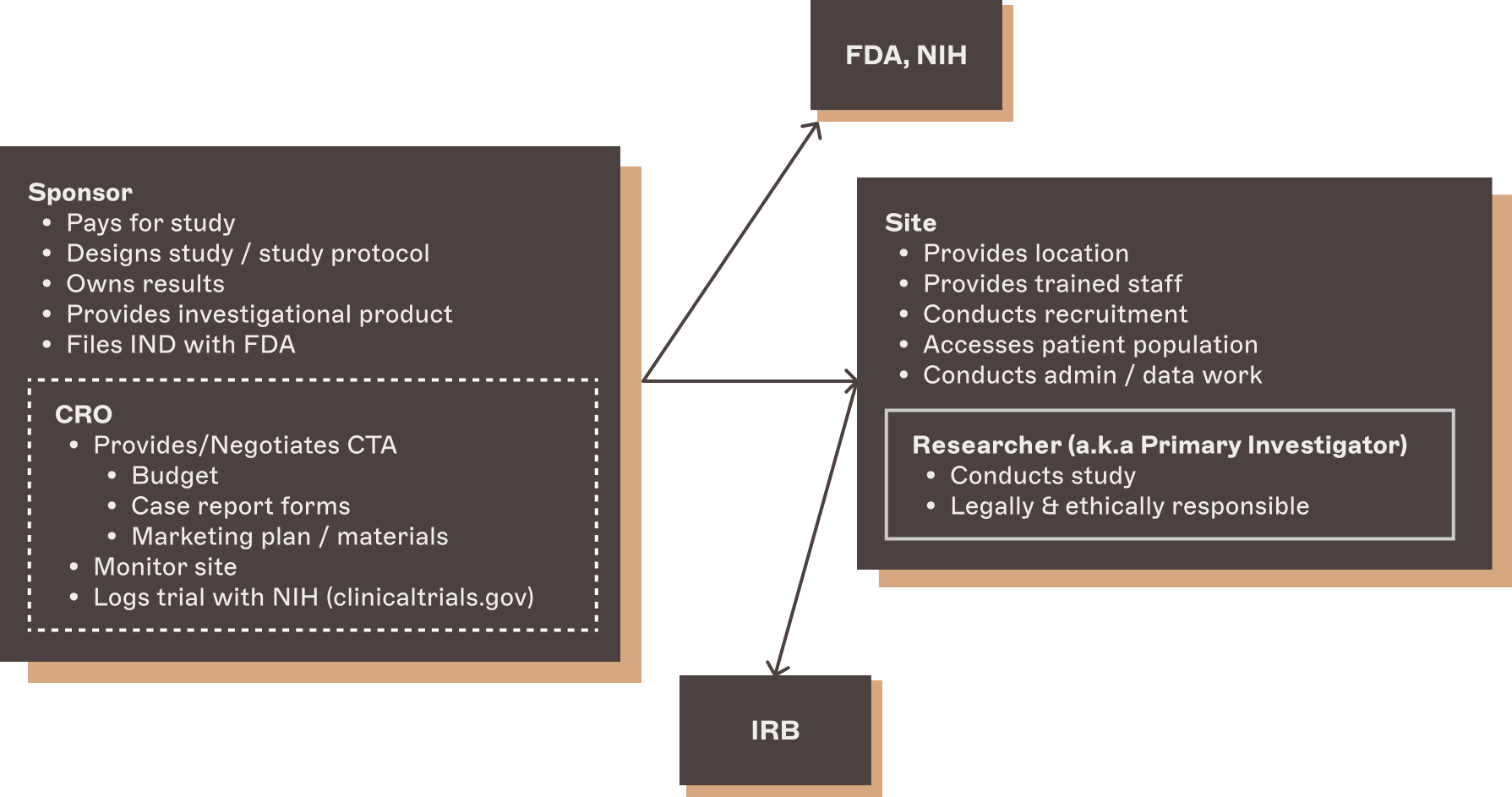
A diagram of the roles and relationships in clinical trials

Site Management Organizations, site networks, Patient Access Organizations, and the market

Increasingly, market pressures and convenience of working with one party instead of many have led to the creation of intermediary layers between sites and sponsors or CROs. The longest-standing version of the site-side consolidation layer is called a Site Management Organization, which is essentially a vertically integrated counterpart to the CRO. SMOs offer faster study activation, ease of negotiation and relationship management, streamlined establishment of standard operating procedures (SOPs), and recruitment advantages. SMOs emerged starting in the 1990s and have remained a participant in the research ecosystem since, but have never become as dominant a model on the research side as CROs have on the sponsor side.

A more recent trend in site-side coordination is the establishment of independent site networks, which share an interface with a sponsor or CRO in the same manner as an SMO, but are not vertically integrated or wholly owned. Some of the largest site networks are organized and operated by players that also provide other services—for example, WCG and Elligo. Site networks come in a wide range of sizes, ownership structures, and levels of coordination. They also charge a fairly wide range and diversity of fees, and some also charge a membership fee in addition to taking a portion of per-study budgets.

The newest category of site-side coordination organizations is called a Patient Access Organization (PAO), a type of integrated research organization that attempts to solve some of the coordination and recruiting hurdles that SMOs struggled with by expanding even further in the direction of responsibilities typically falling to CROs.

Many recent developments in the market for sites, site networks, and PAOs have been driven by the increased adoption of distributed research practices that began with the push to develop a COVID-19 vaccine as fast as possible in 2020 and 2021. While there was academic research into distributed trial administration prior to the pandemic, the need to coordinate across simultaneous phases and massive numbers of providers (and PIs) drove a significant amount of attention toward resolving the challenges that come with distributed trials. The impact on the space and the interest from new players, like private equity firms, is both complex and ongoing.

Up next: Chapter 3

Minimum requirements to participate in clinical trials as a research site

The upfront investments, personnel, and facilities capacity AICs need to become trial sites.
Continue