
Demand for fertility services is at a record high, with the U.S. market projected to top $21 billion by 2035. Surging interest comes as Americans are choosing to start families later, employer-sponsored plans expand coverage, and infertility rates rise across male and female patients. Providers are racing to open up capacity, however, access remains uneven.
To understand the state of fertility care in 2026, we analyzed how clinic ownership, competition, and care access have evolved since 2024. This report compares every U.S. fertility center in Inside Reproductive Health's 2024 and new 2026 ownership reports, and maps patient access across U.S. cities. Here are the takeaways.
A note on methodology: Our team reconciled the 2024 and 2026 source lists through exact-name matching, location and ownership analysis, and manual review of apparent openings, closures, acquisitions, and rebrands. We generally come to the same conclusions as the source documentation, but depart from IRH’s classifications when clinic websites, transaction announcements, CDC/NASS records or other primary evidence demonstrates a duplicate clinic, outdated ownership attribution, or other error. For a full list of where we diverged from IRH and a workbook of our analyses, email our team.
Independent clinics lost ground to fertility networks
Over the past two years, the market grew by approximately 35 clinics, increasing from 485 in 2024 to 520 as of September 2026.
This analysis tallies the total number of clinical locations with an on-site IVF laboratory and independent ART programs that provide IVF and have their own NASS Clinic ID. Satellite offices without an on-site IVF laboratory were not included in the total market count.
Twenty-one existing centers, or roughly 4% of the market, changed hands during the study window. Fourteen independent clinics were acquired by networks during the study period, three clinics moved between networks, three were absorbed into health systems, and one returned to independence.
After the reshuffling, independent clinics still maintain hold of the largest market share, with 229 independent facilities representing 44% of fertility clinics nationwide. However, their dominance is declining. In 2024, independent clinics accounted for nearly 48% of all facilities.
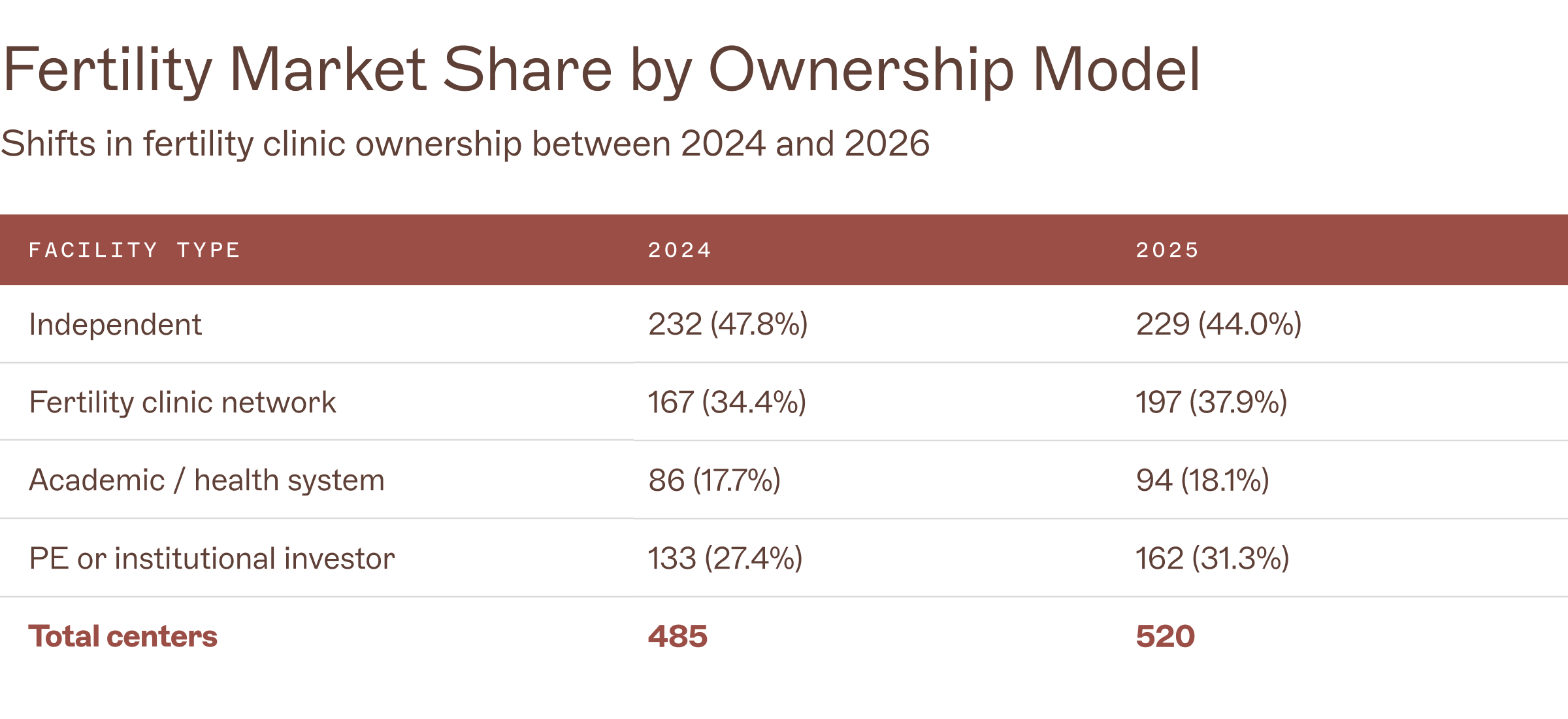
Independent facilities were unable to keep pace with fertility clinic networks’ expansion. Networks added 30 facilities to their fold, mostly through de novo builds.
For example, Wildcat Capital Management-backed Spring Fertility opened five new clinics or ART programs to the dataset, including locations in Denver, Long Island, Oakland, San Francisco, and Portland. Meanwhile, IVI RMA and U.S. Fertility each added three new locations to their portfolios.
Still, the pace of consolidation is slow compared to 2022 peaks. In that year, global private equity investment in reproductive health led to 41 buyouts totaling $8.4 billion, including KKR's approximately $3.2 billion acquisition of IVI-RMA Global. Analysts have suggested that private equity owners are now placing a greater emphasis on operational profitability versus expanding their geographic footprint.
And, it’s important to note that while independent facilities may be at heightened risk for acquisition, zero independent facilities shuttered entirely between 2024 and 2026.
Consumer choice varies sharply by market
The largest metropolitan markets remain the least consolidated.
New York is home to 43 clinics, 25 of them independent, spread across 39 distinct owners. Los Angeles and Orange County offer 51 clinics, 28 independent, across 40 owners. Dallas-Fort Worth (18 clinics, 50% independent), South Florida (11 clinics, 55% independent), and Houston (13 clinics, 46% independent) also host enough clinics to offer patients ample selection.
However, choice narrows considerably in smaller and mid-sized markets.
Salt Lake City and Charlotte, for example, have no independent clinics at all. Denver, Boston, and Seattle have slightly more options, with Denver supporting two independent clinics and the other cities home to a single independent practice.
The data indicate consolidation occurs frequently in these mid-size markets. Network-affiliated clinics grew from 28.6% of the Seattle market in 2024 to 57.1% in 2026, the sharpest shift in the country. Indianapolis rose from 28.6% to 42.9%, Detroit climbed from 12.5% to 25%, and Raleigh-Durham went from no network presence to 14.3%.
Reporting the number of brands active in a market may also overstate consumer choice in some cases.
Sverica Capital, for example, is listed as an investor in both CCRM, which operates 20 clinics nationally, and First Fertility, which operates eight. The two networks compete directly in Chicago and Boston. Amulet Capital holds a stake in GIVF Fertility in Fairfax, Virginia — which was marked as an independent facility by IRH — and also backs U.S. Fertility's 32 clinics.
Nationwide, Amulet Capital is linked to 33 clinics, L Catterton to 32, KKR to 29, and Sverica Capital to 28, meaning each investor is linked to roughly 6% of the national market.
Notably, the source material does not distinguish stake size, or direct from indirect holdings. In some markets, a shared investor may not be the same thing as common control. Still, for other physicians and patients, distinct branding may not mean a clinic operates differently from the option down the road.
Care deserts remain a pressing concern
Between 2024 and 2025, markets that already had the most options for care expanded. California added 12 clinics, New York six, and Illinois four — together accounting for 22 of the 35 net additions.
Meanwhile, residents of Alaska and Wyoming must leave their states entirely to access IVF. Both states have zero clinics — a gap that sits unchanged from 2024. Wyoming's nearest facilities sit in Salt Lake City and Denver, each roughly a five- to eight-hour drive from the state's population centers.
Several states offer only one clinic. For patients in Maine, New Hampshire, Montana, North Dakota, and South Dakota, residents can be multiple hours away from services or live closer to clinics across state lines.
The gaps in care may reflect in part the intense competition for qualified providers. Despite growing demand for care, there are just 1,500 board-certified reproductive endocrinologists practicing nationwide, and nearly three quarters of IVF laboratory directors recently reported difficulty filling open positions. Most of the talent pool is concentrated in large markets where clinics already are. For many of these markets, the labor required to open a lab may not be there.
Limitations
This analysis was performed on two snapshots of data, published by Inside Reproductive Health. The sources did not include volume data, so our analysis treats each individual location as processing an equal number of patients. Because acquired practices skew large and new independents skew small, center counts almost certainly overstate the independent segment's real market position.
The source material also relies on publicly available information to determine ownership. The data may not reveal the full scope of partnerships, minority investments, or lab-only ownership that complicate the consolidation question. For example, RMA at Jefferson is a clinical partnership between Jefferson Health and RMA of Philadelphia, with ties to IVI RMA but no ownership by it. So this report classifies the center as academic.
Finally, we used approximate 2025 population estimates to map geographic markets and total population as a proxy for women of reproductive age. Metro areas were also assembled by hand from city names rather than a formal crosswalk.
For questions about our methodology or to submit a correction, please reach out to our team.